
Rooted
A lotus never loses its roots in the riverbed. Our training stays rooted in the Kalakshetra tradition: its grammar, discipline and aesthetic.

इन्दीवरा
in · dee · va · ra · Sanskrit, noun
The blue lotus.
The word
Indīvarā (इन्दीवरा) is a Sanskrit word for the blue lotus, the blue water lily that opens on still water.
In classical Sanskrit poetry the blue lotus is a favourite image of beauty. Poets compare graceful eyes to its petals and describe the dark-hued divine as having its colour.
Like every lotus, it grows from the riverbed, rises through the water, and opens petal by petal into the light. We chose the name because that is what learning a classical art feels like.
Why this name
Three ideas behind the name, and how they shape the way we teach.
A lotus never loses its roots in the riverbed. Our training stays rooted in the Kalakshetra tradition: its grammar, discipline and aesthetic.
It grows patiently through the water toward the light. Our students grow the same way, step by step, from first adavu to full margam.
It opens petal by petal into its own form. We help every dancer open into their own artistic voice within the tradition.
The emblem
Our emblem is a hand-drawn ink illustration of a dancer surrounded by blue lotuses. Tap a point to explore its details.
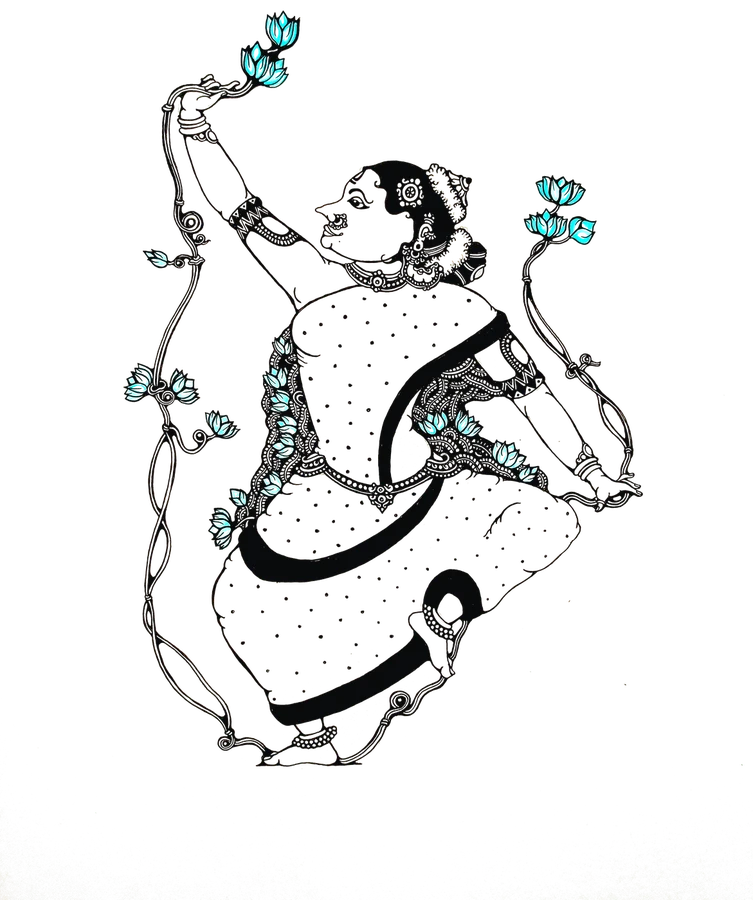
The only colour in the drawing. These are the indīvara that give the academy its name, blooming from the dancer's own hands.
Flowers in the hair, ornaments and jewellery are drawn in fine detail, a nod to the care and preparation that classical performance demands.
Dots and patterns in the textile echo the rhythm and precision of Bharatanatyam. Every small mark counts, just as every small detail of a step does.
Long stems run from the hands down to the ground. The dancer is held by them, rooted and rising at the same time.
Arms reach outward, holding the stems with care. In Bharatanatyam the hands carry meaning, and the lotus itself is one of the gestures dancers learn.
A grounded stance and the anklets every dancer wears. Rhythm begins at the feet.
The lotus in the dance
The lotus is part of a dancer's vocabulary. Among the hastas (hand gestures) of Bharatanatyam are two lotus shapes:
“Lotus bud.” Fingers curved and apart, as if holding a round fruit or a closed bloom.
“Fully bloomed lotus.” Fingers fanned open one after another, like petals unfolding.
From bud to bloom: the journey we hope every student makes.
Our colours
The blue of the lotus, the depth of still water and the white of the page the emblem is drawn on.
#081446#1D3FD8#9DB2FF#FFFFFFBegin to bloom